


Can You Do Pilates During Pregnancy? A Safe Guide for Every Trimester
Updated: Mar 26
Can you actually do Pilates during pregnancy — and is it safe?
This is one of the most common questions I hear.
Pregnancy can feel confusing — your body changes, your energy shifts, and suddenly you’re not sure what’s right anymore. There’s a lot of advice out there, and not all of it feels clear or helpful.
If you’ve ever thought, “Maybe I should just be careful and not move too much…” — you’re not alone.
Let’s break down what’s truly safe, what your body needs, and how to move through each trimester with confidence — plus a few key answers at the end.
Is it better to rest and avoid movement during pregnancy?
It might feel like the safest choice — to slow down, move less, and try to “protect” your body by doing as little as possible. But in reality, the body works differently.
When you stop moving, blood circulation slows down, oxygen delivery decreases, and your energy drops. And your baby depends directly on these systems.
A body without movement doesn’t restore energy — it loses it.
Movement, on the other hand, activates everything: blood flow, breathing, energy production at the cellular level. This is how your mitochondria work — the more intelligently you move, the more energy your body is able to produce.
So the goal during pregnancy is not to stop.
It’s to move in a way that supports your body.
What does safe movement actually look like in the first trimester?
The first trimester is often the most unexpected.
You may feel tired in a way you’ve never felt before.
Nausea, sensitivity to запахи, emotional shifts — everything feels new, and sometimes overwhelming.
And very often, there’s fear.
Fear of doing something wrong.
Fear of harming the baby.
Fear of moving at all.
This is where guidance becomes incredibly important.
Because gentle, well-adapted movement does not harm a healthy pregnancy.
If pregnancy loss happens, it is not caused by exercise. It is a biological process, and it’s important for women to understand this — so they don’t carry unnecessary fear.
In the first trimester, I always shift the focus away from “training” and toward support.
We work with:
• breathing
• releasing tension in the diaphragm
• soft, controlled movement
• calming the nervous system
And this is where something very simple becomes incredibly powerful — breath.
When you learn how to breathe properly, you can:
• reduce nausea
• ease pressure in the stomach
• improve oxygen delivery
• bring your body into a more calm, stable state
This is not just about feeling better now — this is also preparation for birth.
How does movement change in the second trimester?
By the second trimester, many women start to feel more like themselves again.
There’s more energy, more stability — but at the same time, the body begins to change more visibly.
Your posture shifts.
Your center of gravity changes.
Your abdomen grows — and with it come new questions.
Can I still engage my core?
How do I move safely now?
What should I avoid?
This is exactly where Pilates becomes such a valuable tool.
Because we’re not just exercising — we’re teaching your body how to adapt.
We focus on:
• deep core activation without creating pressure
• pelvic stability
• alignment and posture
• controlled, intentional movement
And gradually, your body begins to feel more supported instead of confused by all these changes.
And what about the third trimester?
The third trimester is often the most physically intense.
Your body feels heavier.
Your breathing changes.
Movement becomes slower, sometimes more limited.
And this is usually the moment when women think:
“Maybe I should just stop..”
But in reality, this is when movement becomes even more important — just in a different way.
Now the focus shifts toward:
• reducing pressure in the back and pelvis
• improving mobility
• working with breath for labor
• learning how to release tension
Because birth is not about pushing harder. It’s about how your body responds, adapts, and lets go naturaly.
And a body that has been moving throughout pregnancy:
• understands how to coordinate
• knows how to activate and release
• knows about the bones rhythm, especially the pelvic bones
• recovers much faster after birth.
How does movement affect your baby?
This is something many women don’t hear enough. Your movement directly supports your baby’s development.
When you move, your circulation improves, oxygen delivery increases, and your baby receives better nourishment.
Your body is your baby’s environment.
And when that environment is active, supported, and well-functioning — your baby benefits from it, both during pregnancy and beyond.
A gentle but important reminder
You can choose to move less.
You can choose to stay still.
But it won’t give your body more energy, more support, or more comfort.
Movement — when done correctly — is one of the most powerful tools you have during pregnancy.
My approach to prenatal Pilates in Miami
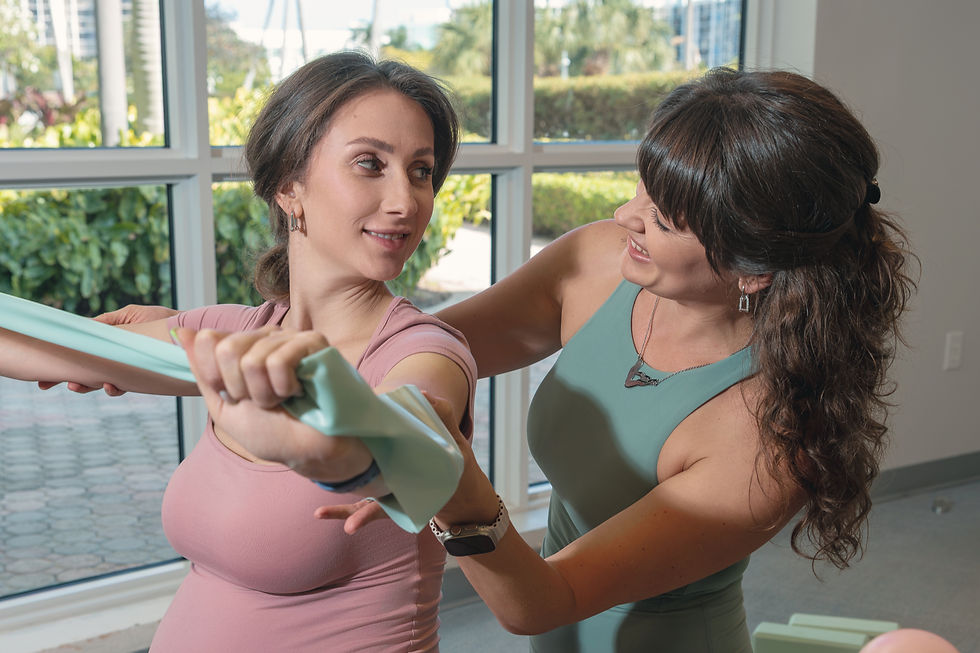
I work with women through all stages of pregnancy, and my goal is never to push the body — but to support it.
Every session is:
• personalized
• gentle, but effective
• adapted to your body and your stage
I guide you not just through exercises, but through understanding your body.
So you can feel:
• safe
• confident
• connected
Start Prenatal Pilates with me
You don’t need to stop moving.
You need to move with understanding and support.
📍 Private sessions in Miami & online
👉 Book your session
👉 Message me to get started
Pilates can be practiced with minimal equipment, making it accessible to everyone. However, certain props can enhance your practice:
Mat: A good quality mat provides cushioning and support.
Reformer: This specialized equipment adds resistance and variety to your workouts.
Resistance Bands: These can be used to increase the challenge of certain exercises.
Pilates Balls: Small balls can help with balance and stability.
Take the first step today and discover how Pilates can enhance your life.


Comments